Custom AI agents for Lehigh Valley businesses
Put one repeatable task on an agent, with clear permissions, human review, and a record of each run.
Om Concepts builds custom AI agents for Lehigh Valley businesses that need work handled across documents and business tools. A project starts with a defined workflow, such as intake triage, document review, or quote preparation. The build includes access boundaries, test cases, human handoffs, and run records your team can inspect.
Your agent core
Your agent core
What clients say
Apps and systems used in real businesses.
“Alex has built and deployed several apps and projects that make managing my business easier”
Donald Mayock
Custom apps & business systems
“from web design and google analytics to AI and automation support.”
Mike Cimerola
JAM Graphics and Printing · web, analytics, AI & automation
Review excerpts verified .
3 options
Packages
Pick one to start. We can resize or combine later if the work calls for it.
Starter Agent
Businesses needing one focused production agent
2-3 weeks
- Single-purpose agent (intake, FAQ, scheduling)
- Connection to 1-2 data sources/tools
- Deployment and launch support
- Testing and refinement
Pro Agent
Teams requiring multi-step reasoning and integrations
4-6 weeks
- Multi-tool AI agent
- Knowledge base ingestion and retrieval
- Automation triggers and guardrails
- Analytics dashboard
Agent System
Businesses scaling AI across multiple workflows
6-10 weeks
- Multi-agent orchestration
- Cross-platform data pipelines
- Human-in-the-loop approval workflows
- Ongoing tuning and advisory option
Agent builds start at $3,000. Scope determines the implementation fee; model usage, third-party tools, hosting, monitoring, and ongoing support are identified separately in the proposal. Bring a redacted example input and the name of the person responsible for approving the output.
Scope and fit
Plan the first useful step
Start with a defined job
Possible scopes include classifying an inquiry into the right queue, extracting fields from a document for review, or preparing a quote draft from approved records. The proposal names the input, allowed actions, output, system of record, and human approval step. These are project examples, not claimed customer results.
Know when to use an agent
A task with fixed rules may only need an integration. A person drafting or researching may get more value from a well-configured AI workspace. An agent earns its place when it must interpret input, choose among permitted actions, and leave enough evidence for a person to review the result.
Agree on the acceptance tests
Test expected work, missing information, conflicting instructions, unavailable tools, and requests outside the agent's permissions. Review completed tasks, corrections, escalations, failures, elapsed time, and cost per run. The handoff identifies who can pause the workflow and how failed work is recovered.
Explore the work and options
- Inspect Om's routing system
An internal Om Concepts case. Its visual examples carry their own provenance; they are not a customer performance claim.
- Map an agent workflow
A planning worksheet for inputs, actions, approvals, and evidence.
- Compare workflow automation
Use predictable rules where a model does not add value.
- Prepare your team's AI tools
Build useful working habits before delegating a whole process.
Working across the Lehigh Valley
Serving businesses across the Lehigh Valley, including Allentown, Bethlehem, Easton, and Whitehall. In-person work is arranged during scoping; remote delivery is available. Each engagement defines access, responsibilities, and the evidence used to review the result.
Explore our service areaWhat this solves
- 01Intake, FAQ, or scheduling work eating skilled hours
- 02Off-the-shelf chatbots that cannot touch your systems
- 03No governed architecture for AI agents
Three layers, one agent stack.
Anatomy
Three layers, one agent stack.
Every agent we ship is a combination of a model, an ability layer, and the surface it runs on.
- Model
- Claude, GPT, Gemini, and local open-source weights. The brain. We pick per job and keep the cost curve honest with caching and batching.
- Ability
- Retrieval, memory, tool use, computer use, voice, and vision. The body. What the agent can read, recall, call, operate, hear, and see inside a bounded loop.
- Surface
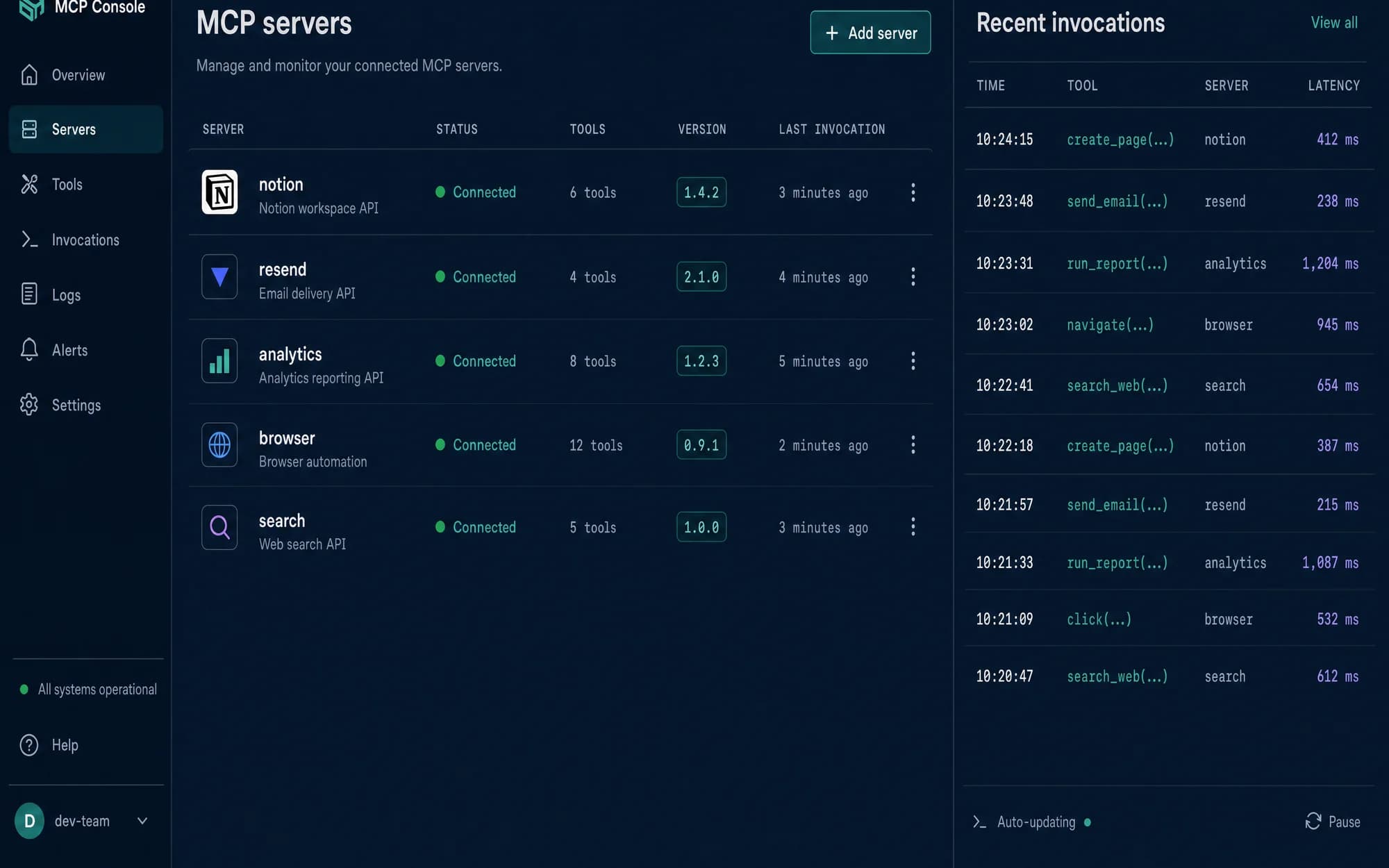
- Web, MCP servers, email, phone, CRM, and Notion. The environment. Where the agent meets your customers, your team, and your systems of record.
What you get
How the engagement runs
Click any phase to see what ships
Evidence and review
- Project acceptance tests cover allowed actions, human handoffs, and unavailable tools
- Run records connect the input, attempted actions, output, and review status
Shipped with this service
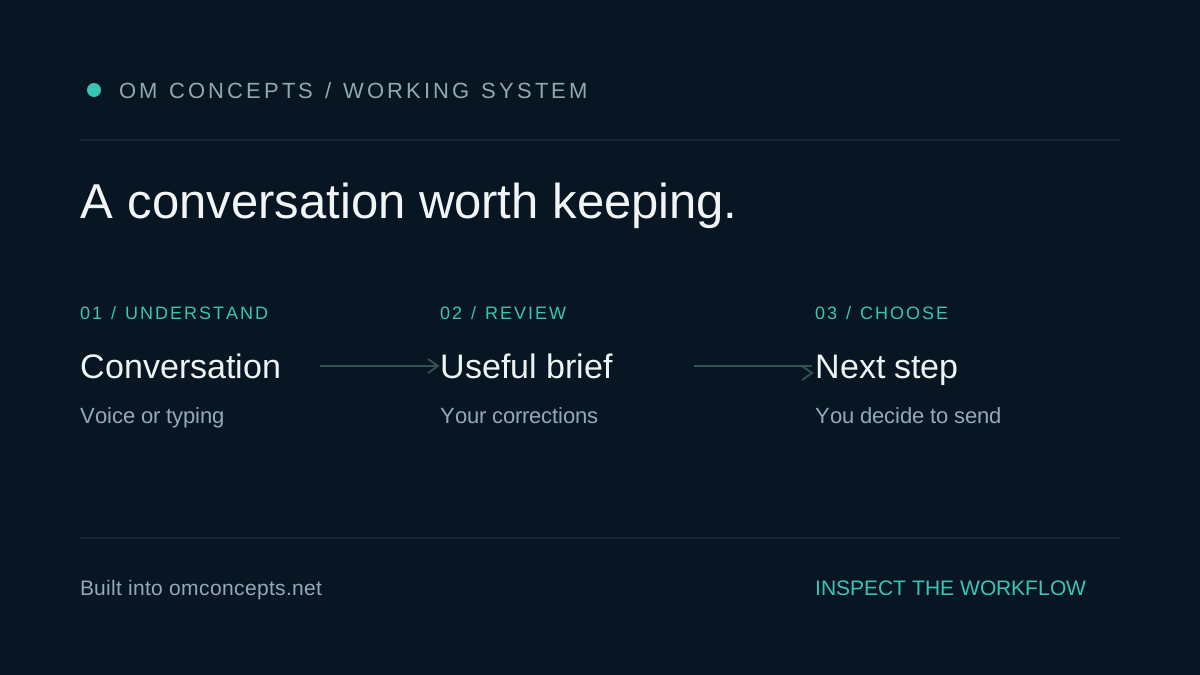
Om Website Consultation Agent
Try Om Concepts' website consultation: voice or text, an editable brief, optional follow-up permissions and a visitor-controlled handoff to Alex.

Om Concepts Signal Routing Agent
Internal control-room agent that classifies incoming business signals before they become tasks, client actions, or follow-up decisions.
What the work looks like
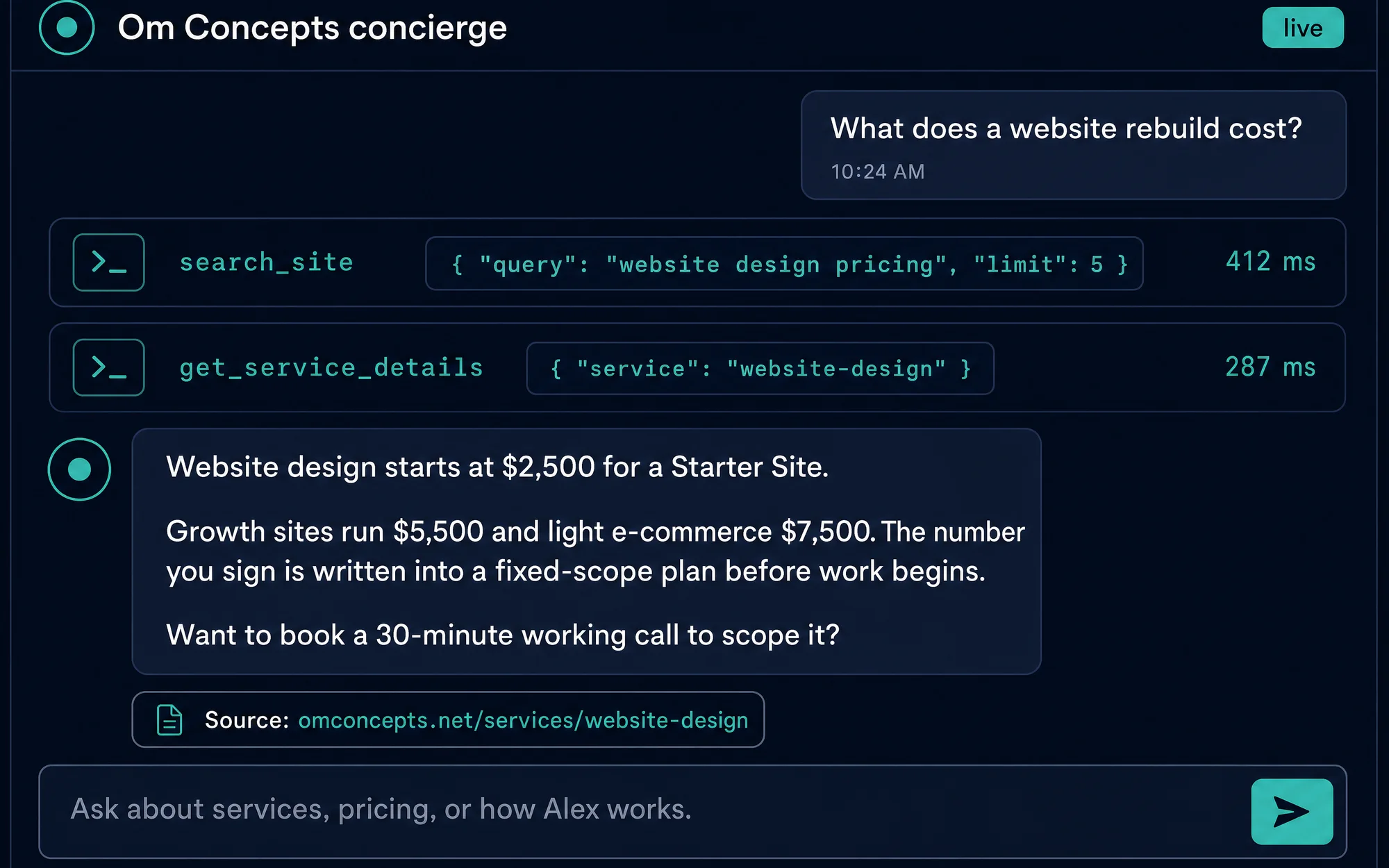
3 artifacts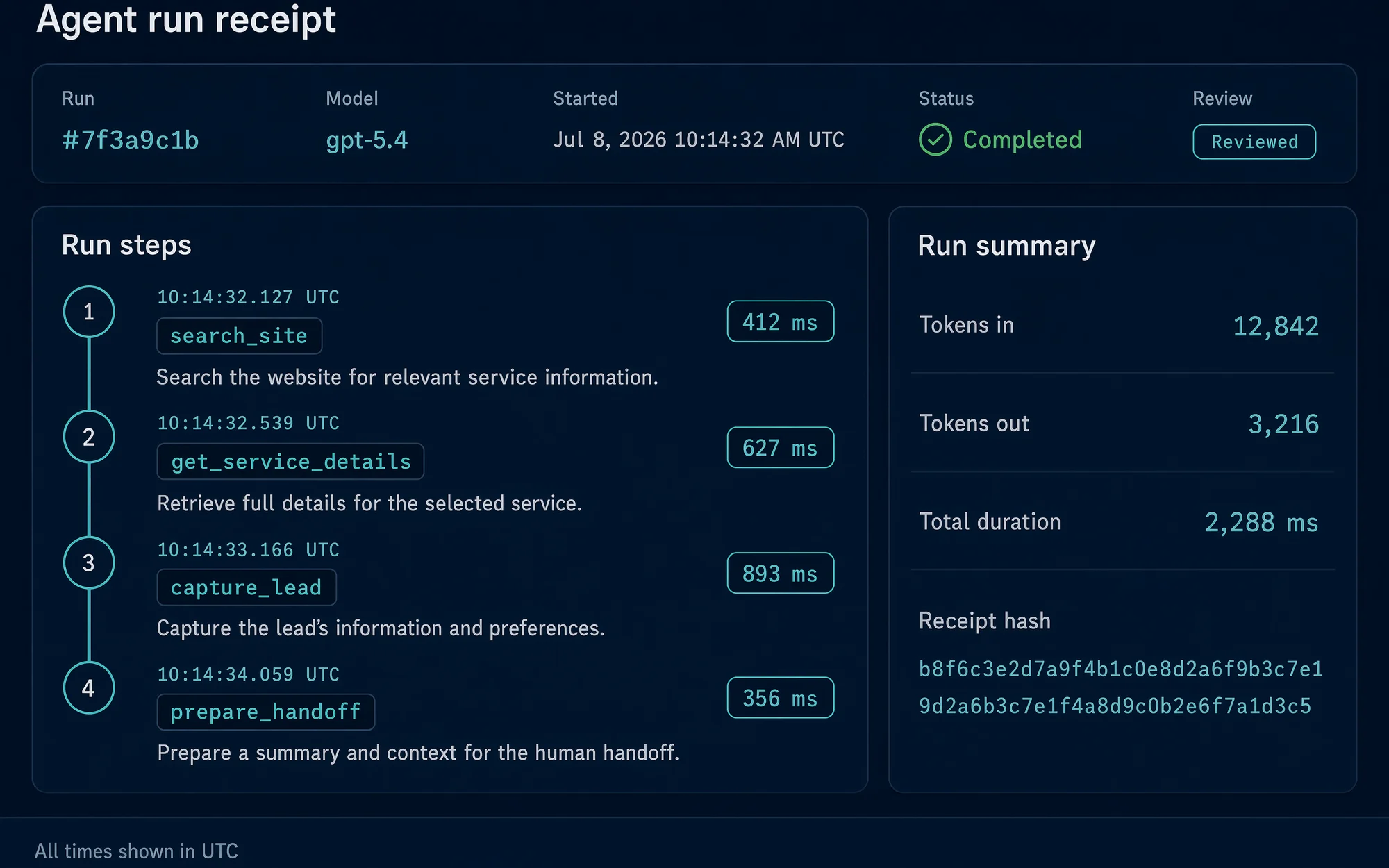
Common questions
What makes this different from a chatbot?
A chatbot answers questions. An agent does work: it reads the request, calls your tools, writes the result into your system of record, and logs every step. You can open any run and see exactly what it did.
Which workflows make good first agents?
One workflow with a clean input and a clean output. Intake, FAQ triage, scheduling, quote prep, and document processing are common starts. If the inputs are messy, we fix the inputs first.
What happens when the agent is unsure?
It escalates. Every agent ships with escalation rules, rate limits, and a budget. When a run crosses a line, a human gets the handoff with full context.
Do we need our own AI subscriptions first?
No. Agents run on API access we stand up under your accounts, so you own the keys and the data. We pick the model per job and show you the cost curve.
Can it work with our existing tools?
That is the point. Agents connect to your CRM, inbox, calendar, and internal systems through tools we wire up per engagement. If a system has an API, it can usually join the loop.
Ready to scope AI Agents?
Thirty-minute working call. You leave with a direction, fit or not.