Every business I work with wants to move faster. Most try to get there by adding something: a new tool, a new hire, a new campaign. In my experience, speed shows up when the pieces you already have start working together, and it lasts when you can prove it.
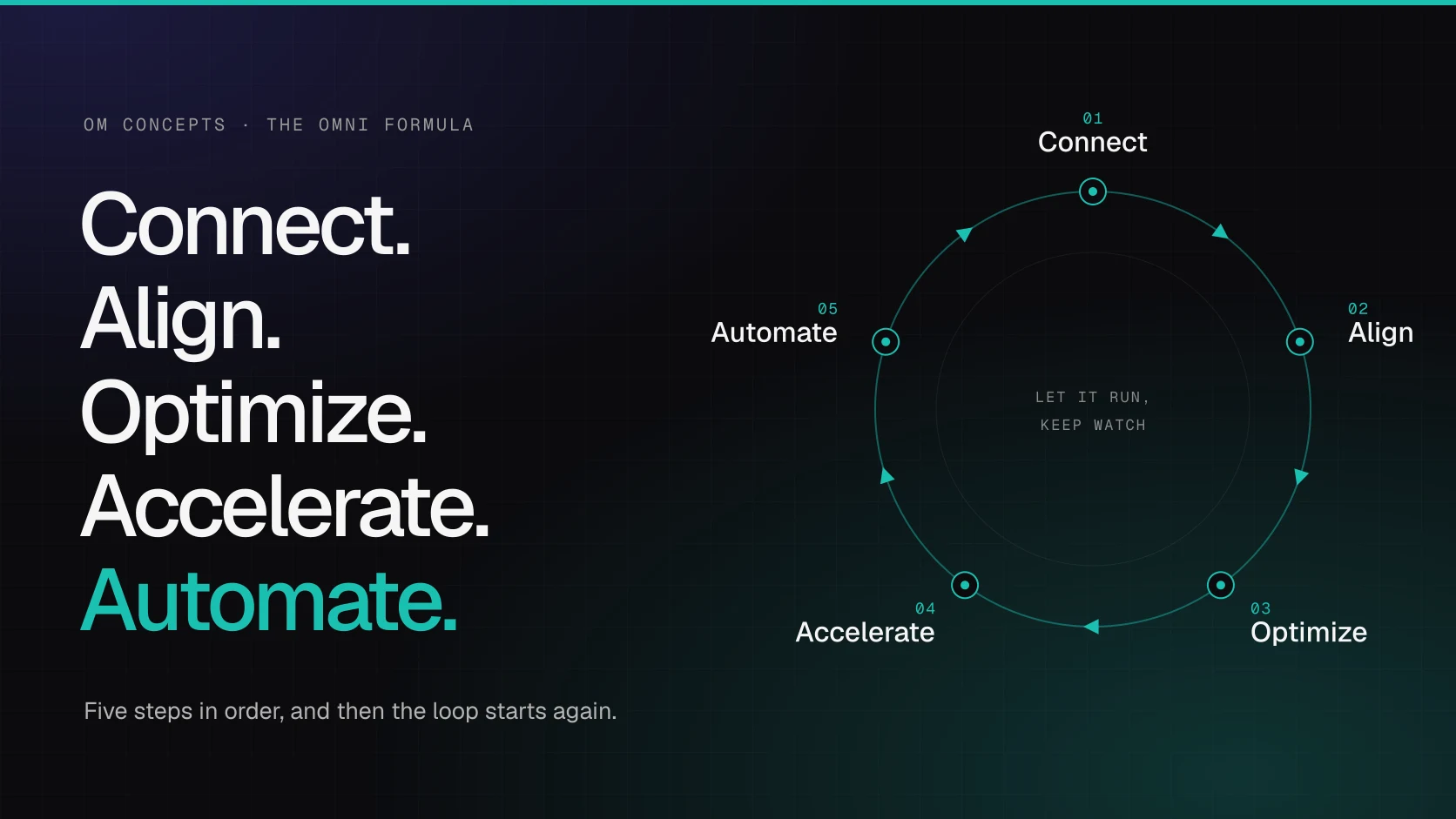
The Omni Formula is how I think about that. It has five steps that run in order and then loop: connect, align, optimize, accelerate and automate. It works the same way on a business, a team, a single person or a client relationship.
- STEP 01ConnectRemove walls, build bridges.AskCan we reach each other?Channels · Routes · Access
- STEP 02AlignUnderstand and be understood.AskAre we headed the same way?Roles · Context · Goals
- STEP 03OptimizeEffective and efficient.AskAre we getting better together?Invest · Refine · Compound
- STEP 04 · Repeat workAccelerateAs within, so without.AskAre we moving faster?Discover · Recognize · Create
- STEP 05 · Repeat workAutomateLet it run, keep watch.AskCan it run on its own?Trigger · Verify · Guard
Whatever you create or automate becomes the next thing to connect, so each pass through the loop runs faster than the last.
Connect: can we reach each other?
Connect means removing walls and building bridges. Before anything else, the people, tools and records involved need a working route to each other.
Start inside your own house. How does a lead get from your website to your inbox to your calendar? Where do your customer records live, and who can see them? Map the channels and routes you already have, and mark every place where work gets stuck or copied by hand.
Then look outward to your customers, vendors, partners and the platforms you rely on. Can they reach you the way they want to, and can you reach them?
What to look at: channels, routes and access. Connect is done when you can answer yes to one question: can we reach each other?
Align: are we headed the same way?
Align means understanding and being understood. Once everyone can reach each other, check that they share the same context, the same goals and a clear sense of their own role.
Inside the business, that might mean one shared plan in place of three spreadsheets, or a clear answer to who follows up on a new lead. Outside, it means your structure and direction match the people you work with. A vendor working toward a different deadline, or a client expecting a different outcome, is a gap you'll pay for later.
What to look at: roles, context and goals. Align is done when everyone involved can say yes: are we headed the same way?
Optimize: are we getting better together?
Optimize means becoming effective and efficient. Once you're connected and aligned, you can improve without guessing, because you can see the work and you agree on what good looks like.
This is the step where the work itself changes. Invest in what's working, refine away what's blocking you, and cut the steps that don't need to exist at all. Then let the gains compound. On a team, that means leaning on each other's strengths and clearing each other's blockers.
What to look at: invest, refine and compound. Optimize is done when the answer is yes: are we getting better together?
Accelerate: are we moving faster?
Accelerate takes one piece of work you repeat, like quoting a job or onboarding a client, and makes the same work happen in less time. The work stays what Optimize made it. What changes is the timing: the order of the steps, the handoffs and the waiting in between.
It runs in three moves. Discover how long the work takes today, so you have a baseline. Create the faster version and run it for real. Recognize whether it actually beat the baseline. If it didn't, you haven't accelerated yet.
What to look at: discover, recognize and create. Accelerate is done when the numbers say yes: are we moving faster?
Automate: can it run on its own?
Automate is for work that Accelerate already proved faster. Automating something that isn't proven only repeats the waste at a bigger scale.
Every automation needs a trigger that starts it at the right moment, a check that verifies the result each time it runs, and a guard that stops it and calls a person when something looks wrong. Start with a small test run, and widen it only when it has earned that.
This question has three honest answers: yes, it runs on its own; not yet, which sends you back a step; or no, this one stays human, because some work should. The principle is simple: let it run, keep watch.
What to look at: trigger, verify and guard. Automate is done when you have a clear answer: can it run on its own?
Three rules for using it
- In order. Connect before you align, align before you optimize, optimize before you accelerate, and accelerate before you automate. Improving something that isn't connected or aligned only speeds up the drift.
- Within, then without. Every step starts inside your own house: your tools, your team and your records. Then it reaches outward to customers, partners and the platforms you work with. Prove and automate inside first, before anything that touches someone else.
- One question per step. A step is done when its question gets a clear yes. If it doesn't, go back a step. Accelerate and Automate are for work you repeat. One-off work stops after Optimize.
The formula is a loop
Whatever you create or automate becomes something new to connect. A new service needs a route to customers. A new hire needs context and a role. A new automation needs to talk to the tools you already have. That's when the formula starts again.
Each pass makes the next one faster, and you can see it in your numbers over time. That's the real acceleration.
Find your starting point
Answer the questions in order. The first no is where to start.
- 01 · CONNECTCan we reach each other?
- 02 · ALIGNAre we headed the same way?
- 03 · OPTIMIZEAre we getting better together?
- 04 · ACCELERATEAre we moving faster?
- 05 · AUTOMATECan it run on its own?
Questions 4 and 5 are for work you repeat. One-off work stops after Optimize.
Answer in order. The first no is where to start.
Where Om Concepts fits
This is the lens I bring to the work at Om Concepts, whether the job is a website, a marketing system or an agent that handles intake. We map what's connected, agree on roles and goals, improve one thing at a time, prove it got faster, and only then let it run on its own.
If you want a second set of eyes on where your business stands, bring one workflow to Om Concepts and we'll walk through the five questions together. You can also email alex@omconcepts.net.